
Educational Materials in Economic History
Economic History teaching in UK Universities
A census of economic history teaching in undergraduate economics programmes at UK universities, documenting the availability, content and departmental provision of compulsory and optional modules.
Share your own materials
Welcoming contributions from across the UK higher education community and beyond
Overview and survey courses
Economic History and History of Economic Thought
Amanda Gregg, Middlebury College
"We will study the “big ideas” of economic history and the history of economic thought. […] Along the way, we will learn a bit of the history of economic thought by reading some of the great economic thinkers and considering how they thought about the context in which they wrote."
- Syllabus (Fall 2024)
- Handout: 3 Kinds of Economic History Research Questions (.docx)
Global Economic History
Vsevolod Ostapenko, Durham University
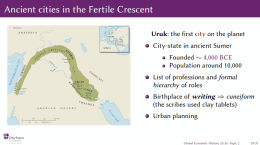
Introductory course aiming to "[p]rovide students with an understanding of historical roots of economic growth and diverging trajectories of development in different countries and regions of the global economy. / Facilitate students' understanding of important developments and crises in the history of the world economy."
International Economic History
Andrew Seltzer, Royal Holloway, University of London
"This is a survey module offered in the second term of the 2026-27 academic year. [...] The major topics covered are economic growth and wellbeing, agricultural and urban development, pandemics, the expanding economic role of women, globalisation and migration, banking and monetary systems, and the Great Depression and recovery."
Economic History
Chris Colvin, Queen’s University Belfast
"This final-year undergraduate module is an introduction to the two interrelated fields [of economic history and historical economics]. The topics chosen are taught in a roughly chronological order, starting with the demographic transition and ending with Britain’s exit from the European Union."
- Syllabus (2025)
World Economic History II
Christopher M. Meissner, University of California, Davis
"This course introduces students to the evolution of the global economy since the early 19th century."
- Syllabus (Spring 2026)
Contextualising the World Economy
Eoin McLaughlin, Heriot Watt University
"The course covers a wide range of themes and highlights recent advances in the literature relating to debates surrounding the industrial revolution, pollution, and sustainability."
- Course handbook (2025/26) (.docx)
Topics in Economic History
Cédric Chambru and Jade Ponsard, École Normale Supérieure de Lyon
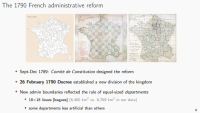
"This graduate-level course offers an introduction to quantitative economic history, and involves the study of a broad-ranging theme, occasionally drawing on insights from other disciplines such as political science and history."
Understanding the Global Economy in the Long Run
Christopher M. Meissner, University of California, Davis
"This course is intended for graduate students and advanced undergraduate students in economics or other related fields."
- Course outline (Winter 2025)
Introduction to Economic History
Carol E. Heim, University of Massachusetts, Amherst
1st year PhD course "introduces broad themes in economic history by exploring a small number of topics in depth. […] Particular emphasis will be placed on the development of economic, political, and legal institutions."
- Syllabus (Fall 2021)
History of Capitalist Development in Europe and the World Economy
Carol E. Heim, University of Massachusetts, Amherst
Upper-level PhD course "assumes that students are familiar with the material […] on the transition from feudalism to capitalism". "Examines the emergence and evolution of capitalist forms of economic organization, and their interaction with noncapitalist forms. It begins with the Atlantic economy, dispossession of Indigenous land, the slave trade, and global trade networks, then turns to industrialization in Britain, France, Germany, Russia, Mexico, and South Africa."
- Syllabus (Spring 2023)
Specific topics and regions
Death, Migration and the Great Irish Famine
Chris Colvin, Queen’s University Belfast
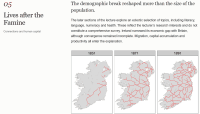
- An interactive teaching resource exploring the economic causes and consequences of the Great Irish Famine, with historical evidence, discussion questions and downloadable lecture materials.
History of Money and Banking
Stein Berre, Federal Reserve Bank of New York
"The course was aimed at practitioners rather than academics and draws heavily on visuals / PowerPoint slides. Peter Conti-Brown and William Goetzman helped as second readers for different portions of these materials."
- Reading list (2025) (.docx)
- Slides for topic 1: Overview and Introduction to Course Materials
- Slides for topic 2: Europe until 1700
- Slides for topic 3: Europe until World War I
- Slides for topic 4: US until the Gilded Age
- Slides for topic 5: US until World War II
- Slides for topic 6: The Post-war order until the Present
- Slides for topic 7: The 2008 Financial Crisis and its Aftermath
Theory and Measurement in Economic History
Amanda Gregg, Middlebury College
"This [upper-level elective] course aims to introduce you to the modern economic historian’s toolkit and to teach you the field’s standards for scientific writing. Along the way, we will read economic history’s 'Greatest Hits,' amazing journal articles that use a variety of methodologies to answer big questions."
- Syllabus (Spring 2021)
- Handout: Guided Questions for Learning a Paper (.docx)
- Handout: Types of research questions (.docx)
United States Economic History since the Civil War
Christopher M. Meissner, University of California, Davis
"This course introduces topics in the economic development of the United States since the Civil War. […] requires no prior knowledge of U.S. history."
- Syllabus (Spring 2026)
Economic History of North America to 1914
Vincent Geloso, Bates College, Maine (now at George Mason University)
- Overview, lecture slides, and midterm exam (Winter 2019) (external link)
Economic History of Canada to 1914
Vincent Geloso, King’s University College, Ontario (now at George Mason University)
"This class offers a comparative history of North American economies with a heavy focus on Canadian economic history (in the light of American comparisons)."
- Syllabus and lecture slides (Fall 2019) (external link)
American Economic History
Carol E. Heim, University of Massachusetts, Amherst
"This course is a survey of U.S. economic history from colonial times to the present. We will examine the evolution of capitalist and non-capitalist institutions and study ways in which economic development has been uneven across space, time, and economic groups or classes."
- Syllabus (Fall 2018)
- Guidelines for Papers
Senior seminar: History of the Firm
Amanda Gregg, Middlebury College
"In this course we will trace the history of firms from the Classical Age to the present, using theoretical and empirical economics to understand what makes a 'firm,' how firms have been organized throughout history, why firm organization may differ across countries […], and what firm structure implies for economic performance."
- Syllabus (Fall 2023)
- Handout: Types of research questions (.docx)
- Handout: Big Questions about Firms (.docx)
- Handout: What Is Methodology? (.docx)
- Handout: Thesis Statements: The Glue That Holds Your Paper Together (.docx)
- Take Home Essay Question 1 (.docx)
- Take Home Essay Question 2 (.docx)
China Since 1800: Culture, Institutions and Economic Growth
Melanie Meng Xue, London School of Economics
"The first half of the course focuses on facts and follows a chronological order, covering major phases of historical China, including pre-1800 China, the Great Divergence, late Qing and Republican China, Communism, and post-1979 economic and political reform. The second half of the course is more analytical[.]"
- Reading list (2024/25)
External links
- The Economic History Association (US) has syllabi from Economic History courses between 2010 and 2020.
- The Economic History Podcast by Seán Kenny (University College Cork) is available on Apple Podcasts, Spotify, Amazon Music, and other podcast platforms. "Each month we meet leading academics in the field and discuss a range of topics, including pandemics, long run economic growth, gender issues, financial crises, inequality, sustainable development and a number of weird and fun economic experiments in history." As of November 2026, there are 48 episodes.
- CAGE Economics Podcast by the CAGE Research Centre, University of Warwick, exploring how Western Europe overtook China and India to become the epicentre of the world economy. "Five podcast episodes of 45-60 minutes each along with written summaries, graphs, links, and other useful resources"
- The English Merchant Shipping, Trade, and Maritime Communities project at the University of Southampton has produced online databases of maritime trade and communities from the 15th to the 18th centuries, as well as downloadable materials and teaching notes for activities using the data. These are addressed to a range of educational levels.
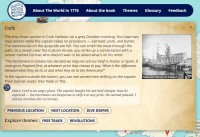 The World in 1776 by Maha Rafi Atal, Jacob Harber, Anna Judelsone, and others, University of Glasgow, is an interactive site aiming to "reconsider the legacies of slavery, empire, free trade, and revolution in the making of the modern economy", which was developed as part of the Wealth of Nations 250th project. The reader follows a sailor on a merchant vessel, witnessing the brutality of the transatlantic slave trade, then travelling to India, China, and Indonesia and seeing the dominance of the East India Company.
- The Discover Economics project has videos and classroom materials on topics including some economic history topics. Although the primary audience is school-level, there are data exercises that can be used at university level.
- The resources published by Federal Reserve Education, aimed at a variety of educational levels, include some on economic history. These include lesson plans on Inflation and the Fall of the Roman Empire, Panic of 1893, Mercantilism and the British North American Colonies, and A Cotton Tale: The United States’ First Industrial Revolution (1790-1840). Some of their resources can be downloaded for use in Virtual Learning Environments such as Blackboard or Canvas; this requires free registration. See for example Sold Fast: Price Tags and the Impact on Consumer and Producer Surplus or Fruit of the Boom: The Impact of the Industrial Revolution on Economic Growth
Resources by type
Teaching and learning materials

These teaching materials for Economic History are being shared by a partnership between the Economic History Society and the Economics Network.
The collection is curated by Dr Chris Colvin, Queen's University Belfast.