
Barriers to Student Engagement with Economics Support Schemes: Insights from First Year Students
Introduction
“The first few weeks of tertiary study is a time of high vulnerability with many new demands, when old supports have been left behind and new ones not yet generated.” (Farnill and Robertson, 1990, p.179)
The transition to university can be difficult for all students as they enter an environment that is new with its own language, customs and practices. The Department for Education (2021) highlights that common new student concerns include mental health support, student finance, and adapting to university life and study practices. This is supported by the findings from Jones and Frydenberg (2000) who investigated first year university students’ level of academic stress in the first semester. The main academic stressors students reported included: exams and results, essays and projects, forgotten assignments, timing and spacing of assignments, the need to do well, both self-imposed and imposed by others, and financial problems (Jones and Frydenberg, 2000). It is also well documented that students need to navigate the hidden curriculum of higher education and economics in specifically (Mearman, 2024; Jones and Frydenberg, 2000).
Universities generally provide a range of resources and support schemes to ease the transition and promote student success, including academic, pastoral or holistic and peer-led initiatives. However, despite the availability of these resources, student engagement is often low and many times inconsistent. For economics students particularly, there is a big difference between how A Levels are taught and assessed compared to university level economics, and these documented differences can make the transition to university economics studies more difficult (see Johnson and Squires, 2024 for further details). Therefore, it is important to investigate the reasons for this observed low engagement, particularly when there is a high supply of support schemes, and understand the factors that shape student experiences.
I conducted a pilot study focusing on first-year student experience with economics content support schemes. First year students were selected because they are uniquely positioned as newcomers to the environment, to reflect on the clarity, effectiveness, and accessibility of the support available compared to other students who already have experience with university systems.
Institutional Context and Support Landscape
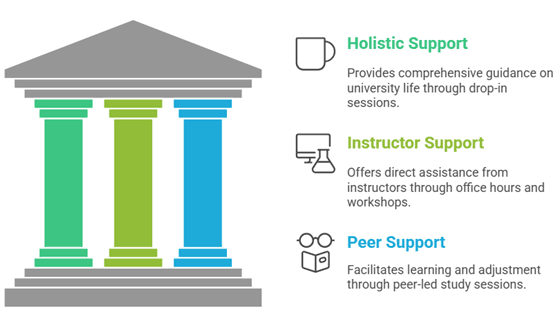
The content support schemes offered to first-year students at the studied Russel Group institution are summarised in Figure 1.
Figure 1: First Year Student Support Structure
author-generated using Napkin AI
- Instructor-led Support: This includes office hours, discussion boards and an optional online workshop for the introductory economics units.
- Peer-led: First-year students had a peer-supported (and academic-coordinated) learning scheme. The weekly drop-in sessions for this scheme are facilitated by high-performing second-year students, where the focus is on discussion of formative tasks rather than formal teaching.
- Holistic: In 2024/25, academic staff in collaboration with colleagues responsible for key services required to succeed at university such as academic advising, student progression guidance, disability support, skills development, careers advice, and library support, delivered informal drop-in Support Café sessions. The aim of these sessions was to provide guidance to students, promote a sense of belonging and community, and to signpost key services.
Focus Group Findings
This case study offers an initial exploration of how first-year economics students engage with academic support schemes and what factors shape their experiences. The findings presented are drawn from three focus group discussions with first-year economics students.
1. The Schemes are Useful and Valuable
Students report that when they use the support schemes, they find them very beneficial. Unsurprisingly, there is variation in which schemes are found useful. For example, some students find peer-led schemes valuable for second-year student insights into units they have already taken; other students question the reliability of the student leaders and find instructor perspectives more useful. Some students find office hours valuable for the ease with which instructors can help students identify their knowledge gaps, while others avoid it because of knowledge gaps. It is encouraging that students identify the benefits of the schemes and in their own words:
“From my past experience, I think [peer scheme] is like the most beneficial to me by speaking to students only in the year above you who’ve done well on the same course that you’re doing as well compared to like the others where like the lecturer can’t tell you too much about what’s coming up in the exam or they can’t help you too much with the coursework but the leaders at [peer scheme] can.”
“...then in [the spring term] I went for a lot of office hours and also used a discussion board but I generally felt like the office hours were really really helpful... So like going to a lecture is really good because they can also help to like quickly identify what you don’t know.”
“I use [peer-led], I feel like it was really good because it was led by like the high achieving, like the most high achieving students from that year.”
“I used the Café. I found that it was good to like, settle in, but I only used it when it was active in the first part of [term 1].”
However, there are many barriers that often lead to low engagements, these formed the bulk of the discussions in the focus groups. Students were very open about what factors prevented them from engaging with different support schemes.
2. Awareness and Understanding Gaps
Throughout the discussions, the students indicated a low level of awareness regarding the services offered during the first term of their university life. Students indicated not knowing that they could access office hours:
“I didn’t use any other resources except for like, discussion board, also because like, I don’t really know that you could go and ask the lecturers during your office hours for anything. So a lot of it’s like, just I’m being unaware I didn’t think I could actually just go.”
Additionally, some students indicated that, given everything that they need to adjust to, they made decisions about what support was important. Often the focus was on their course materials and classes rather than optional services.
“When you first come into uni you’re adjusting to everything… figuring out lectures, course materials, all this important stuff. That takes priority, so being aware of things like [peer-led scheme] and [support café] wasn’t my top priority. I just didn’t know about them until they came back to reintroduce themselves, and that was a lot more useful than at the start.”
This quote also highlights how the re-introduction of support schemes later may improve engagement.
3. Timing and Scheduling Issues
Sometimes, important optional services clash with classes.
“To me probably the biggest problem with office hours, one of them is conflict. So a lot of them actually conflict with our lectures and sometimes the same kind of subject like you are doing… you cannot just make it.”
While scheduling may be difficult, and it is impossible to find a time for services that works for everyone, having office hours for an instructor on a unit that clash with a lecture for that unit may send a signal that the office hour is not important to attend.
Another consideration is online versus in-person. For some students, commuting to university for an optional session that doesn’t last long discourages attendance. The opportunity cost here is too great and so they opt for non-attendance. Online sessions provide a more flexible option for students to attend some of these services.
“It [the Workshop] was on Zoom, so it was much easier to join and work around the schedule… I’m quite far from uni, so going to office hours is a half-hour walk. Just having that kind of virtual option where I could ask anything and listen to other people’s questions, I thought was quite helpful.”
4. Low Confidence and Lack of Preparedness
Instructors sometimes question why students do not seek help despite knowing that they are facing difficulties with the course content. Evidence on student help-seeking behaviour shows that this varies by gender, ethnicity, nationality, academic performance, and year of study (Guerrero and Rod, 2013; Magaard et al., 2017; Disabato et al., 2018). The focus group discussion adds another insight: some students may avoid seeking help if they think they are too behind, as they are not sure where to start.
“I feel like if I fell too behind in the course, like I’m just too confused, I don’t know what to ask. So then if I’m too behind, I ended up not using the office hour, because I don’t know what to ask.”
Some students are also intimidated by their instructors. In this case, instructor encouragement to use resources could increase engagement. Additionally, students indicated it would be useful to have some guidance on how they can use each of the support services.
“In [the Spring term], my lecturer pushed us to use more office hours and just ask more questions. A lot of it, I think, was like a lot of people were just quite intimidated. Yeah, me included.”
“...maybe at the start of the [year] if you were told exactly like what the intended use are for each of the sessions, it would be a better way of knowing when you have a specific problem which one to use.”
Conclusion
The findings from the focus groups highlighted that the range of support services provide value to students when used. They also show why, despite the recognised benefits, these services are underutilized. The main theme that ran across all the discussions is that communication is key. In order for students to engage effectively, support providers (instructors, key university support staff) must first provide information about the support available, clearly and accessibly, and without overwhelming students.
These findings also highlight the importance of not only improving communication but rethinking how support is structured and presented to students in practice. This is explored further in complementary work on co-creating student support, which develops these insights into a set of student-informed recommendations for improving visibility, accessibility, and engagement (Williams Higgins, 2026).
References
Department of Education (2021): “What students need to know about transitioning into higher education,” The Education Hub, https://educationhub.blog.gov.uk/2021/08/what-students-need-to-know-about-transitioning-into-higher-education/
Disabato, D. J., J. L. Short, D. M. Lameira, K. D. Bagley, and S. J. Wong (2018): “Predicting help-seeking behavior: The impact of knowing someone close who has sought help,” Journal of American College Health, 66, 731–738. https://doi.org/10.1080/07448481.2018.1440568
Farnill, D. and M. F. Robertson (1990): “Sleep disturbance, tertiary-transition stress, and psychological symptoms among young first-year Australian college students,” Australian Psychologist, 25, 178–188. https://doi.org/10.1080/00050069008260010
Guerrero, M. and A. B. Rod (2013): “Engaging in office hours: A study of student-faculty interaction and academic performance,” Journal of Political Science Education, 9, 403–416. https://doi.org/10.1080/15512169.2013.835554
Johnson, A., and Squires, A. (2024): “Understanding A Levels and A Level Economics: A guide for Economics Lecturers at Universities”, Ideas Bank, The Economics Network. https://doi.org/10.53593/n4124a
Jones, B. and E. Frydenberg (2000): “Coping with transition: A case for providing resources to first year university students,” Australian Journal of Guidance and Counselling, 10, 81–94. https://doi.org/10.1017/S1037291100004167
Magaard, J. L., T. Seeralan, H. Schulz, and A. L. Brutt (2017): “Factors associated with help-seeking behaviour among individuals with major depression: A systematic review,” PloS One, 12, e0176730. https://doi.org/10.1371/journal.pone.0176730
Mearman, A. (2024): “Transitions into and through University,” The Handbook for Economics Lecturers, Economics Network. https://doi.org/10.53593/n4123a
Williams Higgins, M. (2026): "Creating Better Support: Economics Students’ Recommendations for Success." INOMICS Teach.
Ethics Approval
This study received ethical approval from the University of Bristol School of Economics Research Ethics Committee. All participants provided informed consent prior to taking part in the research, including specific consent for anonymised quotations to be used in publications and other research outputs. Procedures were implemented to ensure anonymity, confidentiality and the right to withdraw. Data were stored securely in accordance with University of Bristol data protection policies.
↑ Top