The Burreaux method: American football breaks to improve class engagement and bonding
"It was a good way to engage with the entire class and reset."
—Anonymous student feedback
Background
ECON 330 is an introductory econometrics undergraduate course at the Lahore University of Management Sciences, Pakistan. It is taken by students beyond their first year and meets twice a week for 110-minute lectures, which include a ten-minute mandatory break. While the lecture length allows time to develop concepts carefully,(note 1) student attention and energy can fade during the long lectures. The ten-minute break in the middle helps, but engagement and energy levels often still decline substantially in the second half of the lecture. Economics Network guidance similarly notes that student attention can begin to decline after around 15-20 minutes and suggests that short breaks, particularly those involving a complete change of activity or some form of entertainment, can help restore concentration and motivation (Sloman, 2024).
To address this drop in attention and energy, I first piloted a more active use of the lecture break in my Econometrics 2 (ECON 438) class in Fall 2025,(note 2) introducing a simplified American football game that became the Burreaux(note 3) method. I used the method again in Econometrics (ECON 330), the course described in this case study, in the following semester. It was built around three connected aims: to get students moving so that they returned to the lecture more alert; to help project teams develop camaraderie away from formal coursework; and to create a shared class ritual that could strengthen engagement across the semester. The first aim is Pomodoro-inspired in the broad sense of using a deliberate reset between periods of concentrated work, rather than following the standard 25-minute Pomodoro schedule.
The social dimension feels especially important amid expanding online and hybrid provision, learning platforms, and AI-enabled tools. These technologies can widen access and flexibility, but they do not automatically create the social presence through which students experience a class as a community. UNESCO's 2023 Global Education Monitoring Report argues that technology should support human interaction rather than substitute for it; a meta-analysis likewise found strong positive associations between social presence and both student satisfaction and perceived learning online (Richardson et al., 2017). In this context, the Burreaux method helps humanise the classroom: for ten minutes, students move, laugh, cooperate and encounter one another as people. It does not reject educational technology, but rather restores a relational and embodied dimension that technology-rich courses can otherwise underprovide.
Brief exercise breaks in university teaching have been linked with attention, enjoyment, and feasibility in earlier work (Fenesi et al., 2018; Hayes, 2024), while playful learning emphasises the value of low-stakes, participatory activity (Whitton, 2018). My purpose, however, was not to reproduce a laboratory exercise protocol or turn football into an econometrics demonstration. It was to redesign an existing lecture break so that physical activity, project-team interaction, and class identity reinforced one another.
The method
During the ten-minute break in each class, I acted as the rolling quarterback. One project team of four or five students played offence and another played defence. I threw every pass. There were no running plays, no running after a catch, no tackling, and no tagging. The offence had four downs, or tries, to score a touchdown. A match normally took four minutes, so the break usually accommodated two matches.
The activity required much less space than might be expected. We normally played in the open instructor area at the front of the classroom or lecture theatre, and I never needed to rearrange furniture. The method also worked well in smaller classrooms with fixed seating. The smallest room in which I used the method had a seating capacity of around 50 students. Because there were no running plays and no running after a catch, players mainly needed enough room to create separation and receive a pass. Desks, chairs, and other obstacles therefore did not prevent the game from working and could even become part of it, as students used the available spaces creatively.
Implementation at a glance
| Element | Design |
|---|---|
| Setting | Two weekly 110-minute econometrics lectures; 74 students across two sections; no special room layout required |
| Break | Ten minutes per class; usually two four-to-five-minute matches |
| Teams | Existing project groups of four or five students |
| Roles | One team on offence, one on defence; I played quarterback and threw every pass |
| Scoring | Four downs to score a touchdown |
| Safety rule | No running plays, running after catch, tackling, or tagging |
| Purpose | A physical reset, project-team camaraderie, and a shared class experience |
The rules were deliberately sparse. Removing running and contact reduced the physical demands and made a short match possible without spending the break explaining a full sport. Keeping the football teams identical to the assessed project teams was the central pedagogical decision. Students met the same peers in a setting where the task was immediate, visible, collective, and fun, rather than another conversation about deadlines or division of labour.
This link also created a real trade-off. Fixed project teams gave the activity continuity, but they were not constructed to be athletically balanced. The survey later showed that this mattered, especially since I ran a full tournament through the semester with regular games followed by playoff games, culminating in a final game (“Econo Bowl”) between the winners of the two sections at the end of the semester.
For the playoff and final games, I occasionally moved the activity outside the classroom: the final section games and the Econo Bowl were played after the final examination in a booked sports auditorium. This was not necessary for the regular activity, but provided a useful end-of-semester capstone and allowed the competitive element to build toward a larger final event.
Student response
Figure 1. Overall student feedback on the Burreaux method
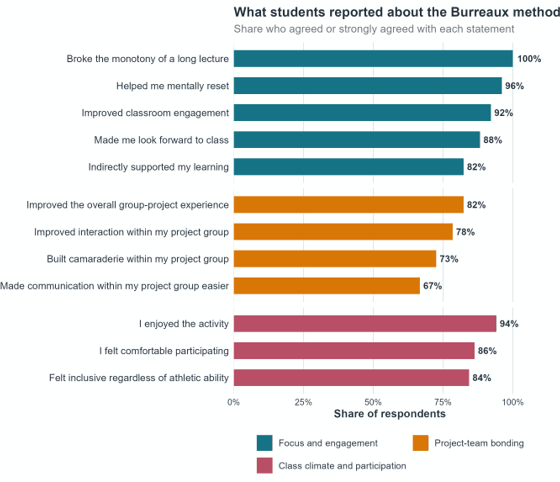
Share agreeing or strongly agreeing. Anonymous end-of-course survey, n = 51. Percentages are descriptive and rounded to whole numbers.
At the end of the course, 51 of the 74 enrolled students completed an anonymous feedback survey (a response rate of 69%). Thirty-seven respondents said they participated almost always, four often, nine sometimes and one rarely. The figures below report the share who agreed or strongly agreed with each statement. These are voluntary, end-of-course self-reports. They describe how respondents experienced the activity, but cannot establish whether the Burreaux method caused changes in learning, focus, or group performance.
The clearest pattern concerns the break itself. Every respondent agreed that the activity broke the monotony of a long lecture, 96% said it helped them mentally reset, and 92% said it improved classroom engagement. Eighty-eight per cent said it made them look forward to class, while 82% felt it indirectly supported their learning. In comments, one student wrote, "The long breaks actually helped with focus." This indicates that students experienced the break as purposeful and re-energising, even though the survey cannot tell us what would have happened without the game.
The project-team results were positive but less uniform. Eighty-two per cent said the activity improved their overall group-project experience, 78% reported better interaction and 73% reported greater camaraderie. The lowest positive share, 67%, concerned whether communication within the group became easier. I therefore see the game as a social complement to project management, not a substitute for explicit support with task allocation, communication and accountability.
Class-climate responses were also positive: 94% enjoyed the activity, 86% felt comfortable participating, and 84% regarded it as inclusive regardless of athletic ability. A student valued "the enthusiasm of everyone involved" and the low stakes of not playing well. Another commented how “It was always extremely fun and engaging and even though I hate sports, I would have a great time”.
Figure 2. Descriptive subgroup patterns by interest in sports and initial familiarity with project teammates
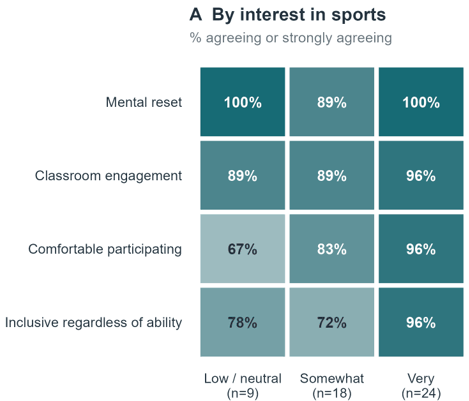
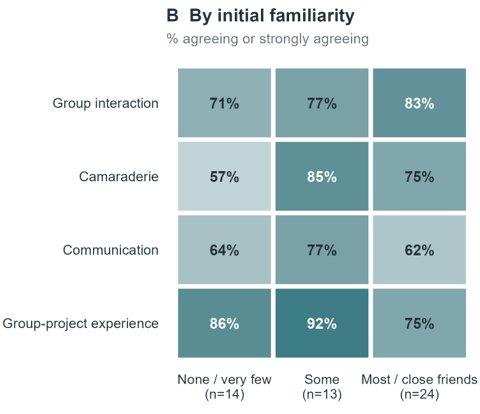
Share agreeing or strongly agreeing. Darker shades indicate a higher positive share. Anonymous end-of-course survey, n = 51. Cell sizes range from 9 to 24, so differences should be interpreted cautiously.
The subgroup patterns help qualify the headline results. Among the nine respondents with low or neutral interest in sports, all reported a mental reset and 89% reported improved classroom engagement. Yet only 67% felt comfortable participating, compared with 96% of those very interested in sports. Initial familiarity with project teammates produced no simple gradient: 86% of students who initially knew none or very few teammates said the activity improved the overall project experience, but only 57% in that group reported greater camaraderie. The activity could be valuable beyond sports enthusiasts or existing friendship groups, but it was not experienced equally by everyone.
A similar warning appears by gender. Among the 21 female respondents, 76% felt comfortable and 76% viewed the activity as inclusive; among the 30 male respondents, the corresponding shares were 93% and 90%. These are small descriptive groups rather than evidence of a causal gender effect, but the gap is pedagogically important. One student explicitly suggested increasing female participation, while others raised height advantage, athletic bias, and unequal teams.
Lessons and trade-offs
Keep team identity, but manage competitive balance. Several comments asked for fairer or more balanced teams. Randomly reconstructing the teams would weaken the link with the group project, so I would instead vary match-ups, rotate receiving opportunities, and make sure the same confident players do not dominate each possession.
Make inclusion operational. No-contact rules are necessary but not sufficient. I could offer meaningful non-playing roles such as an offensive or defensive coach, and check privately whether any student needs a different way to take part.
Experiment with break timing. In these classes I used a single ten-minute break, largely because it was easier to manage in practice. An alternative would be two shorter, roughly five-minute breaks spaced through a long lecture. Given evidence that student attention can begin to decline after 15-20 minutes, this could provide more frequent resets before concentration falls too far, although it would require tighter management of game time.
Causal evidence. I am considering doing this experimentally next year by only implementing the Burreaux method in one of the two Econometrics sections I teach. Since class composition is usually quite similar across my two sections, randomly assigning one section to treatment after enrolment is finalised would allow the control section to act as a good counterfactual.
Conclusion
The Burreaux method turns a routine lecture break into a recurring piece of course design. Its distinctive feature is not American football alone, but the combination of a physical reset, stable project teams and a shared class experience. In this course, respondents overwhelmingly described the activity as enjoyable, mentally refreshing and engaging, and many associated it with a better project-group experience.
The survey also made the limits visible. Comfort and inclusion were relatively lower among students with less interest in sports and among female respondents; fixed project teams were not always competitively balanced; and the activity did less for communication than for engagement or reset. Those are not reasons to abandon the method. They are the design problems to solve in the next iteration. The broader lesson is that engagement is shaped not only by what happens during formal teaching, but also by how we design the spaces around it. A ten-minute break, used deliberately, can help students return to class re-energised while creating the shared experiences and social connections that help a classroom become a community.
Notes
- ^ The two weekly lectures deliver substantive theoretical content to students; a separate mandatory 50-minute lab session is used for applications in Stata and R.
- ^ A student from that Econometrics 2 class created an Instagram reel about the activity, which provides a brief glimpse of the Burreaux method’s initial implementation: https://www.instagram.com/reels/DR7V9kKjN0k/
- ^ Named after my favourite quarterback, Joe Burrow, whose last name was playfully spelled Burreaux during his college football days at LSU.
References
Fenesi, B., Lucibello, K., Kim, J. A. and Heisz, J. J. (2018) ‘Sweat so you don’t forget: Exercise breaks during a university lecture increase on-task attention and learning’, Journal of Applied Research in Memory and Cognition, 7(2), 261–269. https://doi.org/10.1016/j.jarmac.2018.01.012
Hayes, S. M. (2024) ‘Establishing the feasibility of exercise breaks during university lectures’, Frontiers in Sports and Active Living, 6, 1358564. https://doi.org/10.3389/fspor.2024.1358564
Richardson, J. C., Maeda, Y., Lv, J. and Caskurlu, S. (2017) ‘Social presence in relation to students’ satisfaction and learning in the online environment: A meta-analysis’, Computers in Human Behavior, 71, 402–417. https://doi.org/10.1016/j.chb.2017.02.001
Sloman, J. (2024) Lectures in Economics. The Economics Network. Updated January 2024. https://doi.org/10.53593/n3879a
UNESCO (2023) Global Education Monitoring Report 2023: Technology in education – A tool on whose terms? Paris: UNESCO. https://doi.org/10.54676/UZQV8501
Whitton, N. (2018) ‘Playful learning: Tools, techniques, and tactics’, Research in Learning Technology, 26, 2035. https://doi.org/10.25304/rlt.v26.2035
↑ Top