
Learning to Share: A Classroom Game on Cooperation and Resource Use
Introduction
Classroom experiments are widely recognised as effective tools for promoting engagement, strengthening conceptual understanding, and encouraging active learning in economics education (Durham et al., 2007; Dickie, 2006). Strategic interaction games allow students to experience economic decision environments directly, making abstract theoretical concepts tangible and intuitive. Activities that simulate social dilemmas are important because they enable students to observe how individual incentives interact with collective outcomes, a central challenge in many areas of economics, including public goods, externalities, and environmental policy (Holt & Laury, 1997; Brauer & Delemeester, 2001). Experiential learning approaches of this kind help students internalise theoretical ideas through action, feedback, and reflection rather than passive instruction (Kolb, 2014).
This study presents a repeated-round classroom game based on the Tragedy of the Commons, implemented across four cohorts in two universities with students at different levels of study and prior economics knowledge. The activity was used as a pre-lecture experiential exercise designed to introduce the economic problem of common-pool resource management before formal theoretical instruction. Students participated as decision-makers managing access to a shared resource, balancing private incentives to extract against the collective need for sustainability. A punishment mechanism allowed participants to penalise others at a personal cost, adding enforcement, interaction between players’ decisions, and fairness concerns to the game.
Across implementations, the activity generated high levels of engagement and encouraged students to think strategically about incentives, cooperation, and long-term consequences. Behaviour observed during gameplay broadly aligned with patterns documented in experimental economics, while also revealing meaningful variation across cohorts, including cooperation in intermediate rounds and declining cooperation toward final rounds of finitely repeated interactions. At the same time, differences across cohorts highlighted how prior knowledge, expectations, and group dynamics shape strategic behaviour. These features make the activity particularly valuable pedagogically because they create rich opportunities for post-game discussion linking observed behaviour to theoretical predictions.
The game is intentionally simple to implement yet rich in behavioural outcomes, making it suitable for a wide range of teaching contexts.
Context and Cohorts
The game was implemented across four modules at two universities: three at the University of Warwick (second-year undergraduate Intermediate Microeconomics (EC202), third-year undergraduate Economics of Public Policy (EC320), and MSc Public Economics (EC910)) and one second-year undergraduate Microeconomics cohort at the University of Birmingham Dubai campus. Cohort sizes ranged from small postgraduate classes (15 students) to large undergraduate lectures (over 300 students), and students differed in background and prior economics training, with some cohorts consisting primarily of economics specialists and others including students from more diverse academic backgrounds. This diversity allowed the activity to be tested across multiple teaching contexts and demonstrated its adaptability for different levels, cohort sizes, and levels of preparation.
Using a standardised classroom game across multiple cohorts provides pedagogical advantages. It enables instructors to compare behavioural patterns across groups, observe how previous knowledge affects decision-making, and generate discussion about why outcomes differ across settings. It also increases replicability and makes it easier for instructors to adopt and adapt the activity in their own teaching.
Description of the Game
The activity is a repeated-round common-pool resource experiment in which students act as resource users extracting from a shared environment. The scenario is framed as a fishing problem to provide an intuitive representation of a classic economic dilemma. Students make individual extraction decisions while facing collective consequences, allowing them to experience directly the tension between private incentives and group sustainability.
At the start of the activity, students receive a brief narrative description and a set of rules. The instructions are intentionally simple and accessible so that participants can focus on strategic decision-making rather than technical details. The wording used is as follows:
Student Instructions
Stage 1: Fishing round
- All of you are fisherpeople fishing in a local pond. The pond is public so everyone can fish there without any costs.
- Each round of the game you decide how many fish you want to catch: 0, 1, 2, 3, or 4 fish.
- You receive one point for each fish you catch. Your aim is to have as many points as possible by the end of the game.
- At the beginning, the number of fish in the pond equals five times the number of players.
- The game will be played for six rounds.
- After each round, the number of fish remaining in the pond doubles, but it cannot exceed the initial amount. If no fish are left, the game ends immediately.
This structure creates a dynamic resource environment in which students must consider not only their current payoff but also how their decisions affect future availability. The regeneration rule introduces intertemporal trade-offs and mirrors real-world renewable resource dynamics, encouraging students to think about sustainability rather than short-term optimisation.
Stage 2: Punishment round
- The game includes a punishment stage after each extraction decision. Students are given the following additional instructions:
- After catching fish, you may choose to punish other players by giving up one of your own fish.
- You may punish players who caught more than two fish.
- If punishment occurs, each targeted player loses a number of fish equal to the number of punishers minus one.
- At least two punishers are required for punishment to take effect, and no more than four fish can be deducted.
This stage adds a second strategic layer by allowing participants to influence others’ behaviour at a personal cost. Students must therefore weigh the benefits of enforcing cooperative norms against sacrificing their own payoff. The mechanism often generates discussion about fairness, retaliation, and norm enforcement, central themes in behavioural and experimental economics.
Decision Flow and Timing
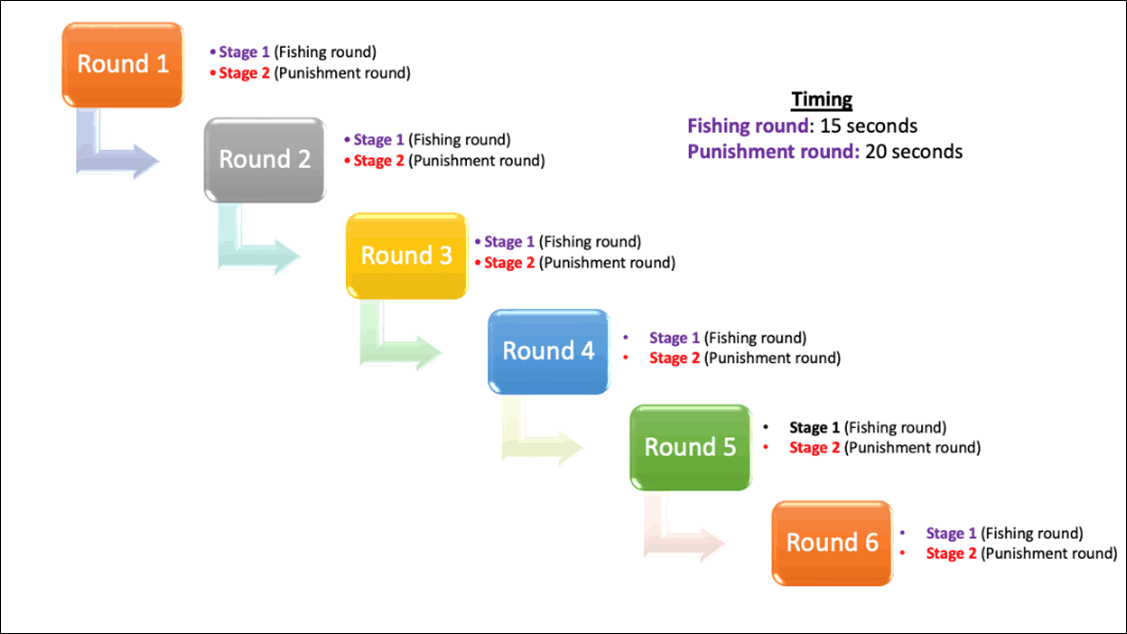
The overall sequence of gameplay stages is illustrated in Figure 1, which presents the flowchart of the decision process. Each round follows the same structure: extraction choice, outcome revelation, punishment decision, resource update, and transition to the next round. Displaying this sequence visually helps students understand the timing of decisions and how their actions affect both immediate payoffs and future resource availability.
Because feedback is immediate after each round, participants often adapt their strategies in response to observed behaviour. Decision times typically decrease across rounds, suggesting learning effects as students become more familiar with incentives and strategic interactions.
Figure 1: Description of stages of the game (click for larger version)
The activity was implemented using the online experimental platform ClassEx, which allows instructors to run real-time classroom experiments and automatically record decisions, outcomes, and response times. This enabled the collection of data across rounds as well as post-game questionnaire responses in selected cohorts. Using a standardised digital platform ensured consistency of instructions, timing, and payoff calculations across groups, while also allowing instructors to display aggregated results immediately for discussion.
Results and Feedback
This case study examines how groups of students engaged with a classroom simulation designed to model the dynamics of a common‑pool resource. Across all groups, the overall trend shows decreasing extraction over time, indicating that students adjusted their behaviour as they observed the consequences of harvesting from a shared resource. The game offers a practical context for exploring theoretical predictions about cooperation, enforcement, and strategic decision‑making in repeated social dilemmas.
Comparison to Theory
Traditional economic theory distinguishes clearly between infinitely repeated and finitely repeated interactions. When a game is repeated indefinitely and punishment is possible, players can sustain cooperation because the threat of future consequences deters overuse. In a finite game, however, this logic unravels: because there is a final round in which future consequences no longer apply, cooperation typically collapses at the end. Prior experimental research supports this pattern, showing that while individuals often cooperate in intermediate stages, extraction rises dramatically in the last period.
Most groups in this classroom activity reproduced these theoretical expectations. In the early and middle rounds, participants demonstrated restraint and an awareness of the shared nature of the resource. Yet, as the final round approached, cooperative norms broke down and extraction increased, illustrating the logic of the tragedy of the commons. Participants recognised that overfishing in the final round could not be punished in subsequent periods, leading them to prioritise short‑term private gains over collective sustainability.
One group behaved differently. Rather than approaching the final round with aggressive extraction, this group maintained high levels of cooperation across all stages of the game. Stock levels in the pond rose and stabilised early, and punishment behaviour increased later in the activity. This suggests that the group recognised the risk of depletion and acted collectively to prevent it. Their behaviour offers an opportunity to discuss how shared knowledge, group cohesion, or strong internal norms can offset incentives to defect, even when theory and standard experimental evidence would suggest otherwise.
Punishment played a significant role across groups, although its frequency tended to decline over the rounds. The relationship between catching and punishing varied widely. In some cases, punishment appeared to be aligned with extraction behaviour, indicating coordinated enforcement and a shared understanding of fairness. In others, punishment seemed more sporadic and less connected to the actual decisions of peers, increasing the likelihood of inefficient or unstable patterns of extraction. These differences provide valuable teaching opportunities to explore how groups construct and maintain informal sanctions in shared-resource environments.
Decision time analysis
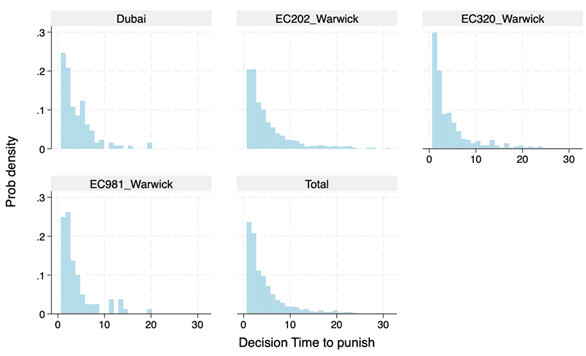
Decision‑time data (Figures 2 and 3) adds another layer to the analysis. Initial extraction choices revealed clear differences in how quickly participants committed to strategies. Some groups made rapid decisions, with only a small number of slow outliers, suggesting a convergence in understanding or preference. Others displayed very short, sharply peaked decision times, which may indicate confidence or predictability. Another group showed a far more varied decision‑time distribution, suggesting diverse approaches or degrees of uncertainty. When it came to punishment decisions, most participants acted quickly, though a subset required considerably more time to decide how many of their own fish to sacrifice in order to sanction others, highlighting the internal conflict inherent in costly punishment.
Figure 2: Probability Density of Decision times to catch fish
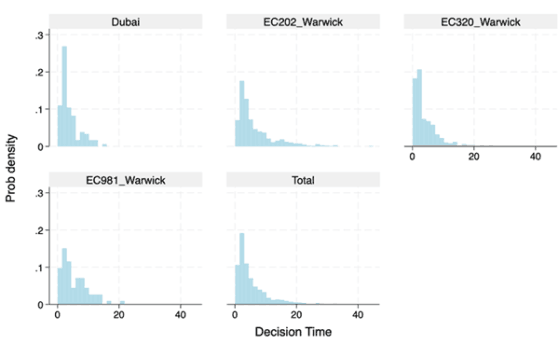
Figure 3: Probability Density of Decision times to punish
Survey results
Students’ reflections captured in the post‑game survey provide rich qualitative evidence of how they understood and engaged with the activity. Many participants emphasised fairness, describing punishment as a response to perceived excessive extraction. Others highlighted the influence of peers, noting that observing the behaviour of classmates shaped their own choices and expectations. Several students adopted a risk‑averse mindset, particularly when uncertain about the fish‑doubling mechanism or when early rounds introduced ambiguity about the consequences of overuse.
Students also described experimenting with different strategies over successive rounds, illustrating a natural process of learning through trial and error. Emotional responses emerged strongly: some reported regret when they felt responsible for resource depletion, others expressed guilt when punished, and some became frustrated when peers behaved in ways they considered selfish. A subset approached the game competitively, focusing on maximising points rather than preserving the resource. Some expressed confusion about certain rules, especially the role of punishment or the doubling of fish, showing that cognitive challenges shaped behaviour as well. A significant number reported acting with long‑term sustainability in mind, and many explicitly connected the activity to real‑world issues such as climate change, overfishing, and deforestation. These reflections demonstrate that the game fostered not only strategic thinking but also emotional and ethical engagement.
Survey responses indicate that students found the activity enjoyable and that it increased their interest in learning about common pool resource problems. Scores and strategies varied across groups, with some reporting more frequent use of long term planning while others displayed more variable performance. Perceptions of risk also differed, with some students seeing the fish-doubling mechanism as neutral and others interpreting it as a source of unpredictability.
Conclusion
Taken together, the behavioural patterns and reflective insights show that students engaged deeply with the complexities of managing shared resources. The activity brought theoretical concepts to life, illustrating the tensions between individual incentives and collective welfare, the role of punishment in promoting cooperation, and the importance of social norms, emotions, and learning in shaping outcomes. As a teaching tool, the game proved highly effective in creating an environment where students could experience, analyse, and reflect on the dynamics that underpin real-world resource management challenges.
References
Brauer, J. and Delemeester, G., 2001. Games economists play: A survey of non‐computerized classroom‐games for college economics. Journal of Economic Surveys, 15(2), pp.221-236. https://doi.org/10.1111/1467-6419.00137
Dickie, M., 2006. Do classroom experiments increase learning in introductory microeconomics?. The Journal of Economic Education, 37(3), pp.267-288. https://doi.org/10.3200/JECE.37.3.267-288
Durham, Y., McKinnon, T. and Schulman, C., 2007. Classroom experiments: Not just fun and games. Economic Inquiry, 45(1), pp.162-178. https://doi.org/10.1111/j.1465-7295.2006.00003.x
Holt, C.A. and Laury, S.K., 1997. Classroom games: Voluntary provision of a public good. Journal of Economic Perspectives, 11(4), pp.209-215. https://doi.org/10.1257/jep.11.4.209
Kolb, D.A., 2014. Experiential learning: Experience as the source of learning and development. FT press. (OCLC 909815841)
↑ Top