
Co-Creating Employability: A Student-Staff Partnership Model for Career Learning
Context and purpose
Students often develop strong analytical, communication and problem-solving skills during their degrees. Yet many struggle to recognise how those skills translate into diverse career pathways. From a human-capital perspective, higher education develops knowledge and skills that can enhance graduates’ productivity and labour-market opportunities (Becker, 1964). Employability, however, depends not only on possessing these skills but also on being able to recognise, articulate and apply them in different professional contexts (Clarke, 2018; Tomlinson, 2017; Yorke, 2006). This can be particularly challenging in the social sciences, where graduates move into a very wide range of sectors, and where the connection between disciplinary learning and particular occupations may therefore be less visible.
To help bridge this gap, we developed the School of Social Sciences Career and Employability Conference, a co-curricular event that has now run for three academic years. It is deliberately interdisciplinary: by bringing together students from Economics and other social science programmes, it showcases the range of careers they can access and helps them recognise how the skills developed through their degrees can be transferred across sectors and professional roles. The conference complements the formal curriculum by creating opportunities for students to connect their academic learning with professional communities (Bridgstock, 2009; Jackson, 2016).
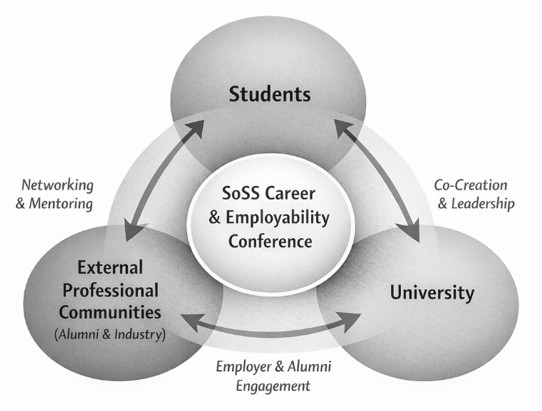
We wanted to go beyond traditional employability talks in which students participate primarily as attendees. Students themselves have valuable insight into the kinds of career questions, opportunities and experiences that matter to them, and the employability literature suggests that incorporating the student perspective can make provision more relevant and engaging (Bridgstock, 2009; Jackson, 2016). We therefore designed the conference around a student–staff partnership model, drawing on research suggesting that co-creation can strengthen students engagement and sense of ownership over their learning (Bovill, 2020; Cook-Sather et al., 2014; Lubicz-Nawrocka and Bovill, 2021). Student societies and volunteers work alongside academic staff and the university Careers Service to shape the programme, identify speakers, organise sessions and host the event. Alumni and employers then bring the external professional perspective. Together, this creates a three-way partnership (Figure 1).
Figure 1. Student–University–Industry partnership framework supporting the conference design.
How it worked
The conference was built around four complementary formats: career journey talks, a cross-sector panel, alumni networking and interactive workshops, each supporting a different aspect of employability development (Table 1). Career journey sessions exposed students to a range of professional trajectories and helped them see how disciplinary knowledge and transferable skills they gained in their degrees can be applied across sectors. The cross-sector panel brought together several professional perspectives on the graduate labour market, employer expectations and the skills that recur across different jobs. Alumni speed-networking then gave students short, direct conversations with professionals, allowing them to practise professional communication, ask questions about career pathways and begin building networks. In the most recent edition, we also introduced pre-conference workshops focused on transferable skills and career decision-making. This combination reflects evidence that career narratives, professional engagement and structured reflection can help students connect their academic skills to professional identities and labour-market opportunities (Jackson, 2016; Tomlinson, 2017).
Table 1: Employability skills supported by the different sessions at the conference
| Learning format | Main purpose | Employability skills supported |
|---|---|---|
| Career talks by alumni and professionals | Exposure to diverse career trajectories and sector-specific experiences | Understanding transferable skills; career awareness; professional identity development |
| Cross-sector panel discussion | Reflection on the graduate labour market and employer expectations | Critical reflection on employability; awareness of labour-market trends; understanding employer perspectives |
| Alumni networking / speed-networking | Direct interaction with professionals from different sectors | Networking skills; professional communication; exploration of career pathways |
| Interactive workshops | Reflection on transferable skills and career decision-making | Transferable skills practice; career decision-making; application strategies |
Note: Skills categories draw on the British Academy’s analysis of the capabilities developed through Social Sciences, Humanities and Arts for People and the Economy (SHAPE) degrees, alongside the graduate employability literature (British Academy, 2017, 2020; Jackson, 2016; Tomlinson, 2017).
Student societies were involved in practical decisions throughout. They helped determine which sectors students wanted represented, suggested and contacted speakers, contributed to scheduling, moderated sessions and, together with student volunteers, supported delivery on the day. Their involvement was important for two reasons. First, it helped ensure that the programme reflected students’ own interests and perceptions of what they needed from employability provision. Second, the process created an additional layer of employability learning for the student organisers themselves. By designing and delivering the event, they were practising leadership, project management, teamwork, stakeholder communication, public speaking and event coordination. Because they were approaching external professionals, working to a fixed date and chairing sessions in front of their peers, these skills were exercised under real conditions rather than simulated ones.
We also made a deliberate effort to include speakers at different career stages and from different sectors. Across the three editions, participants included professionals from public policy, non-governmental organisations, consultancy, finance, technology and data, and multinational organisations. Recent graduates were particularly valuable alongside more senior professionals because they provided students with career examples that felt relatively close and achievable. This is consistent with the role-model literature, which suggests that role models can be particularly influential when students perceive them as similar to themselves and their trajectories as attainable (Morgenroth et al., 2015). Alumni are especially well placed to play this role because they have already made the transition from the same institution, and often from similar degree programmes, into professional employment. Evidence from economics education also suggests that exposure to relatable alumni can influence students’ aspirations and identification with possible career paths (Porter and Serra, 2020).
The sequence of activities also mattered. Students first encountered individual career narratives and sector information, then compared perspectives through the cross-sector panel, and finally moved into direct conversation through networking. The intention was to move progressively from relatively passive exposure towards more active engagement and reflection. Across each stage, the same underlying question was reinforced: what knowledge and skills have I already developed through my degree, and how can I articulate and apply them in a different professional context?
Student response and evidence
The conference recorded 754 session bookings in 2023–24, 719 in 2024–25 and more than 800 in 2025–26. These are bookings rather than unique students, since participants could attend several activities, and roughly 20–30 per cent of registrations did not result in attendance. Even so, most sessions in the later editions were full or close to capacity, suggesting sustained demand for this type of activity.
The evaluation evidence is intentionally modest. The conference was developed as an educational initiative rather than a formal research study, and voluntary feedback response rates were below 10 per cent. We therefore treat the feedback as indicative rather than representative. Students nevertheless raised the same points repeatedly: they valued hearing non-linear career journeys, understanding how analytical and communication skills were used in different occupations, and having access to alumni in an informal setting. The discussion panel and speed-networking sessions were frequently highlighted because they allowed students to ask questions that would be difficult to explore in a large presentation.
Student organisers also reported learning through the process of delivery itself, particularly in project management, communication with external stakeholders, teamwork and event coordination. This distinction between learning as an attendee and learning as a co-organiser became one of the most salient features of the model.
What we learned
Three practical lessons stand out. First, co-creation works best when students have genuine decisions to make. Giving students influence over speakers, formats and themes made the event more responsive and turned organisation itself into a developmental activity.
Second, interdisciplinary design is an advantage rather than a complication. Bringing different programmes and sectors into the same event makes transferable skills much more visible. It also makes it easier to challenge the idea that careers follow a single linear path.
Third, short, timed conversations, clear prompts and a range of alumni make networking easier for students who may have little previous experience of professional events.
There are also practical limitations. Large events require coordination across academic staff, professional services, student societies, alumni teams and external speakers. Registration numbers overstate actual attendance, so room capacity should allow for some no-shows without making sessions feel empty. Finally, optional feedback surveys generate low response rates. Future iterations would benefit from a shorter, embedded evaluation method and from tracking whether students participate repeatedly across the programme.
Transferability
The model can be adapted at department, school or faculty level and does not require a full conference programme. The transferable element is the partnership structure: students co-design the activity; careers and academic staff provide coordination and institutional knowledge; alumni and employers provide professional perspectives. A smaller department could use the same approach for one panel and a structured networking session, while a larger school could run parallel talks and workshops. The essential design choice is to make students partners in deciding what career learning they need, rather than treating employability as something only delivered to them.
References
Becker, G. S. (1964). Human capital: A theoretical and empirical analysis, with special reference to education. National Bureau of Economic Research https://www.nber.org/books-and-chapters/human-capital-theoretical-and-empirical-analysis-special-reference-education-first-edition
Bovill, C. (2020). Co-creation in learning and teaching: The case for a whole-class approach in higher education. Higher Education, 79, 1023–1037. https://doi.org/10.1007/s10734-019-00453-w
Bridgstock, R. (2009). The graduate attributes we’ve overlooked: Enhancing graduate employability through career management skills. Higher Education Research & Development, 28(1), 31–44. https://doi.org/10.1080/07294360802444347
British Academy. (2017). The Right Skills: Celebrating Skills in the Arts, Humanities and Social Sciences. London: The British Academy. https://www.thebritishacademy.ac.uk/documents/217/right-skills.pdf
British Academy. (2020). Qualified for the Future: Quantifying Demand for Arts, Humanities and Social Science Skills. London: The British Academy. https://www.thebritishacademy.ac.uk/documents/1888/Qualified-for-the-Future-Quantifying-demand-for-arts-humanities-social-science-skills.pdf
Clarke, M. (2018). Rethinking graduate employability: The role of capital, individual attributes and context. Studies in Higher Education, 43(11), 1923–1937. https://doi.org/10.1080/03075079.2017.1294152
Cook-Sather, A., Bovill, C., & Felten, P. (2014). Engaging students as partners in learning and teaching: A guide for faculty. Jossey-Bass. ISBN: 978-1-118-43458-1
Jackson, D. (2016). Re-conceptualising graduate employability: The importance of pre-professional identity. Higher Education Research & Development, 35(5), 925–939. https://doi.org/10.1080/07294360.2016.1139551
Lubicz-Nawrocka, T., & Bovill, C. (2021). Do students experience transformation through co-creating curriculum in higher education? Teaching in Higher Education, 28(7), 1744–1760. https://doi.org/10.1080/13562517.2021.1928060
Morgenroth, T., Ryan, M. K., & Peters, K. (2015). The motivational theory of role modeling: How role models influence role aspirants’ goals. Review of General Psychology, 19(4), 465–483. https://doi.org/10.1037/gpr0000059
Porter, C., & Serra, D. (2020). Gender differences in the choice of major: The importance of female role models. American Economic Journal: Applied Economics, 12(3), 226–254. https://doi.org/10.1257/app.20180426
Tomlinson, M. (2017). Forms of graduate capital and their relationship to graduate employability. Education + Training, 59(4), 338–352. https://doi.org/10.1108/ET-05-2016-0090
Yorke, M. (2006). Employability in higher education: What it is – What it is not. Higher Education Academy. http://www.heacademy.ac.uk/assets/documents/tla/employability/id116_employability_in_higher_education_336.pdf
↑ Top