
Realigning assessment and teaching for a mixed-background first-year cohort
Background
Economics for Accounting and Finance is an accredited, compulsory first-year module for accounting and finance undergraduates, following CORE’s The Economy textbook through ten lectures and eight weekly seminars. Enrolment increased from 428 students in 2024-25 to 560 in 2025-26. Many students have not studied economics at A-level, so the module is often their first encounter with economic models and diagrams. Naylor and Smith (2004) found that an economics background did not affect UK economics students’ probability of doing well at degree level, which suggests that the early gap lies more in skills than in prior knowledge. In this module, recurring challenges included interpreting diagrams and payoff matrices, applying quantitative methods and understanding examination expectations.
Until 2024–25, assessment comprised a Blackboard test worth 20% and a 90-minute examination worth 80%, in which students answered two of six long questions. This allowed selective revision, so students could avoid substantial parts of the syllabus, a particular concern in a compulsory introductory module whose core concepts support later study. The format also placed most of the mark on a single examination, and because students answered different combinations of questions, their marks were harder to compare (Allen, Holland and Thayer, 2005).
In 2025–26, I redesigned assessment and aligned it more closely with lectures and seminars. The aims were to encourage engagement with the core syllabus, make expectations more transparent and help students identify misunderstandings before the final examination. This case study describes the changes, first-year outcomes and lessons learned for teaching large introductory economics modules.
Students encountering economics for the first time cannot be assumed to know what university examinations reward; explaining the format, skills and marking expectations from the beginning can help them prepare more effectively.
The redesign
Five linked changes were introduced in 2025-26.
1. Rebalanced assessment. The Blackboard test increased from 20% to 30% of the module mark, while the examination decreased from 80% to 70%. The 60-minute online test comprised multiple-choice and true/false questions drawn randomly from a question bank, covering the first four lectures. This provided an early assessment point, allowing students to receive a mark and identify areas requiring further attention. The invigilated examination nevertheless remained the larger assessment component.
2. A broader examination. The previous choice-based paper was replaced by two sections. Section A comprised four compulsory multiple-choice questions worth 20 marks in total, sampling core concepts across the syllabus. Section B comprised four longer questions, of which students answered two, worth 80 marks in total. These assessed depth through diagrams, calculations and economic reasoning. The examination duration increased from 90 minutes to two hours and 15 minutes, including 15 minutes of reading time. This allowed students more time to review the paper and select their questions without unnecessary time pressure.
3. Exam-aligned seminars. Every seminar included both types of examination question. Students were given time at the start of each seminar to attempt questions before the solutions were discussed. Solutions explained why the correct multiple-choice answer was right and why each alternative was wrong. Seminars therefore provided formative practice, identifying misconceptions while students still had time to address them (Black and Wiliam, 1998).
4. Revised teaching of difficult topics. Topics that had consistently proved difficult were broken into smaller steps. In game theory, for example, students first learned to read and interpret a payoff matrix before applying it to strategic decisions. ClassEx experiments, including a public-goods game, connected economic concepts with practical activities. During lectures, frequent Top Hat polls allowed students to respond in real time, helping me identify uncertainty and adapt explanations where necessary.
5. Explicit assessment literacy. The final lecture became a structured examination briefing covering the paper's format, mark allocation, four assessed skills (conceptual understanding, diagram work, quantitative skills and economic reasoning), and a suggested time plan. A full mock examination and marking scheme demonstrated how marks would be awarded. The briefing also addressed common errors, including overlooking information, describing rather than analysing, using formulas without economic intuition and submitting inadequately labelled diagrams.
Design choices and trade-offs
The redesign balanced breadth of coverage with opportunities to demonstrate depth. Reducing the number of optional longer questions from six to four limited choice, but compulsory questions encouraged engagement with core concepts. Increasing the Blackboard test weighting created a risk that higher marks might reflect the relative accessibility of online assessment rather than stronger understanding. The invigilated examination therefore retained the greater weighting and tested broader syllabus coverage. Question banks, randomised question and option orders, time limits and a single attempt supported assessment integrity. Nevertheless, the appropriate weighting and design of unsupervised online assessment require continued attention, particularly in the context of generative AI.
The longer examination may itself have contributed to higher marks. This was an intentional change: the aim was to reduce time pressure that was not central to the learning outcomes. However, it also means that the results cannot be attributed solely to changes in teaching or question design.
Outcomes
The first year of the redesign coincided with improved module performance as enrolment increased from 428 in 2024–25 to 560 in 2025–26. The pass rate rose from 69.9% to 86.1%, while the proportion scoring below 40 fell from 29.9% to 13.9%. First-class marks increased from 27.8% to 44.1%, and the proportion achieving 60 or above rose from 41.1% to 60.7%.
Figure 1: Module mark distribution before and after the redesign
2024-25: n = 428; 2025-26: n = 560.
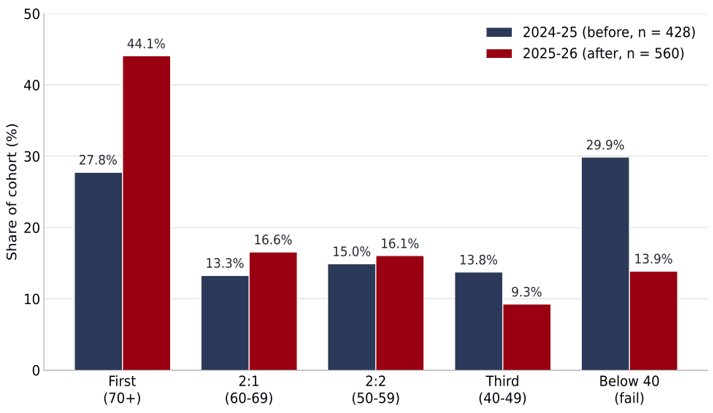
Table 1: Marks by assessment component, before and after the redesign
| Component | Weight 2024-25 | Weight 2025-26 | Mean 2024-25 | Mean 2025-26 | Median 2024-25 | Median 2025-26 |
|---|---|---|---|---|---|---|
| Blackboard test (online) | 20% | 30% | 68.3 | 75.7 | 70.0 | 80.0 |
| Examination (invigilated) | 80% | 70% | 49.1 | 54.7 | 50.0 | 60.0 |
| Module | 100% | 100% | 53.0 | 61.0 | 54.0 | 65.9 |
Table 1 reports marks for each component. Both component means increased, the examination mean from 49.1 to 54.7 and the Blackboard test mean from 68.3 to 75.7. Medians rose by more, from 50 to 60 in the examination and from 70 to 80 in the test. The improvement in the invigilated examination matters because it suggests that the increase in overall performance was not confined to the online assessment component. The change in assessment weighting accounts for only part of the increase in the module mean. Applying the previous 20/80 weighting to the 2025–26 component means would produce a module mean of 58.9, compared with 53.0 in 2024–25 and 61.0 under the revised weighting. As noted above, the longer paper and accessible Section A may also have contributed to higher examination marks.
Student feedback
Module feedback provided students' perspective, although response rates were low relative to the size of the module: 39 students answered a free-text mid-module survey in late October 2025, and 20 students completed the end-of-module evaluation. The comments are illustrative rather than representative.
Students' comments matched the teaching changes, and several linked them directly to understanding. Mid-module, students mentioned "Interesting economics dilemmas and situations", "seminar questions were very helpful " and that "When the lecturer drew graphs by hand makes it easier for us to understand". Top Hat came up in responses, including "Tophat and writing down graphs and explanations with multiple examples" and "Really enjoy econ, Top hat makes it fun and interactive". At the end of the module, students listed "Lots of practice questions to help understand the content" and "Releasing a mock paper" among what worked well.
Feedback also identified areas for improvement, including requests for a slower teaching pace, highlighting the importance of checking understanding across a cohort with different levels of prior knowledge. One student also requested an examination paper at the start of the module. In response, an example examination paper was provided at the beginning of 2026–27, rather than being introduced only towards the end of teaching.
Interpreting the change
The results are encouraging, but they do not establish that the redesign alone caused the improvement. Five changes were introduced together, so their individual effects cannot be identified. The longer examination and accessible compulsory Section A may also have contributed to higher marks. Data on prior economics study and entry qualifications were unavailable; therefore, the analysis cannot establish whether students without A-level economics benefited more, and differences between cohorts cannot be ruled out. The online test's increased weighting also requires monitoring against examination performance and assessment-integrity guidance. As Stankov (2024) notes, assessment format can affect grades independently of measured learning.
Lessons for practice
Four lessons may be useful to teaching large introductory economics modules. First, compulsory questions can discourage selective revision. Students retain some choice among longer questions but must attempt questions sampling core concepts across the syllabus. Second, seminars can provide opportunities to practise assessment tasks. Explaining why incorrect multiple-choice options are wrong can expose misconceptions that might otherwise remain unidentified until the examination. Third, assessment literacy should be introduced early. Students encountering economics for the first time cannot be assumed to know what university examinations reward; explaining the format, skills and marking expectations from the beginning can help them prepare more effectively. Fourth, teaching pace matters in mixed-background cohorts. Checking understanding and adapting explanations to students' different levels of prior knowledge can help ensure that foundational concepts are accessible to all students. Future evaluation will examine performance by students' prior economics study and entry background to identify who benefits most and where further support is needed.
References
Allen, N. L., Holland, P. W. and Thayer, D. T. (2005) "Measuring the benefits of examinee-selected questions", Journal of Educational Measurement, 42(1), pp. 27-51. https://doi.org/10.1111/j.0022-0655.2005.00003.x
Black, P. and Wiliam, D. (1998) "Assessment and classroom learning", Assessment in Education: Principles, Policy & Practice, 5(1), pp. 7-74. https://doi.org/10.1080/0969595980050102
Naylor, R. and Smith, J. (2004) "Degree performance of economics students in UK universities: absolute and relative performance in prior qualifications", Scottish Journal of Political Economy, 51(2), pp. 250-265. https://doi.org/10.1111/j.0036-9292.2004.00305.x
Stankov, P. (2024) "The death of exams? Grade inflation and student satisfaction when coursework replaces exams", International Review of Economics Education, 46, 100289. https://doi.org/10.1016/j.iree.2024.100289
↑ Top