Micro-testing for Econometrics
This case study describes the practice for which the authors won the European Economic Association Award for Innovation in Teaching 2026.
Introduction
Micro-testing is a complementary assessment strategy that involves students sitting a confirmatory 10–12 minute in-class test to verify their understanding of a take-home assignment—such as a report, essay, or briefing note—that they have submitted. In the presence of generative AI, this disarmingly simple teaching intervention helps to mitigate the issue of inflated marks in coursework assessments and, in repeated use, aligns incentives—encouraging students to engage in deep learning activities.
The Problem
The UK higher education sector experienced a post-pandemic shift towards online and take-home assessments; premised on the notion that these types of assessments can enable the testing of higher-order skills, mirror real-world professional tasks, reduce pressure and stress for students who struggle with exam conditions, and provide more equitable opportunities for students with different strengths.
However, with the emergence of generative AI, there are growing concerns about the validity and integrity of remote assessments ("remote" being any assessment not carried out in the presence of academic supervision, such as essays or projects). For example, in econometrics, generative AI is able to write code, interpret output, and produce step-by-step mathematical proofs. More broadly, AI assistants are increasingly able to mimic the type of critical thinking we ideally ask students to demonstrate.
The response to this threat (excluding the institutionally-favoured approach of pretending nothing is wrong) has largely been to either revert to "classic" in-person assessment such as weighty final exams, or alternatively to introduce a range of alternative assessments which are intended to be more resistant to the use of AI. Both approaches have shortcomings:
In-person exams miss many of the benefits of remote assessment, tending to be associated with the assessment of a narrow range of learning outcomes.
Many of the new alternative assessment methods, meanwhile, were premised on exploiting the shortcomings of AI, many of which have rapidly disappeared. Alternatively, they are either very labour intensive or require a paradigm shift in assessment practice which many academics are not willing to entertain.
Micro-testing
It is against this backdrop that we propose the use of "micro-tests" to verify student learning and understanding.
In execution, micro-testing is very straightforward: students’ understanding is verified through a short (10–12 minute) in-class test, usually taking place at the start of a lecture, requiring them to answer questions derived or replicated from a take-home assignment they previously submitted. This is a key characteristic and differentiates micro-tests from a regular unseen class test: the purpose is to assess students’ understanding of, and engagement with, their submitted work, not to challenge them with material beyond the assignment scope. To achieve this, questions are typically short and may include formats such as brief written responses, fill-in-the-gap items, or multiple-choice questions.
These types of confirmatory tests have many desirable properties. First, they provide an empirical estimate of the extent to which students actually understand the work they submitted (which can be interpreted as the amount of work delegated to AI). Second, in repeated use, they align incentives—driving student engagement with remote tasks because students know they will be assessed on this. Third, they operate much like a viva, but their low cost in terms of time and resources makes them scalable in a way that vivas are not (and also more objective). Fourth, unlike many solutions, they do not require a paradigm shift in assessment strategy—meaning they are easy to adopt and implement.
It is important to understand that micro-testing is not about preventing students from using AI, but is, in fact, AI-agnostic: it is not about punishing all use of AI, but really about determining whether students understand work they have submitted and incentivising them to invest time in understanding the work they produce—building domain-specific knowledge and not just prompt-writing skills.(note 1)
Final considerations involve the suitability of the micro-test, timing, and the assessment weighting of the test:
In order to be resource efficient, micro-tests are intended to be standardised, such that all students receive the same (or nearly-identical) test. In order for this to work, it must be the case that all students faced the same (or near-identical) take-home task (e.g. the same essay title, or technical exercise)—thus enabling the production of a uniform question set based on this. Examples of micro-test questions might include interpreting the same regression results table that they produced and interpreted in the course of a take-home task, or labelling or interpreting a diagram which formed the basis of an economics essay.
The timing of the micro-test is important: it should take place as soon as possible after the take-home submission deadline (e.g. in the first lecture afterwards) to a) reinforce that both components form a single assessment, and b) ensure that the knowledge and understanding is fresh in students' minds.
A decision must also be made regarding the weighting of the micro-test. We found that weighting it at 10–20% already had a substantial impact on the distribution of assessment marks, although higher weights may also be justified (remember that the micro-test is a test of the take-home, not a test in of itself). Alternatively, micro-tests can serve as a gatekeeping mechanism, whereby students must pass the test to receive the mark for the remote assessment.
Case study – Level 5 Econometrics
Implementation
We introduced micro-testing in a Level 5 econometrics module with over 150 students from Economics, Finance, and Business Analytics programmes. The module includes two assessment points: a 500-word take-home technical report due mid-semester (worth 20%) and a more substantial 1,500-word report submitted at the end of the module. Micro-testing was incorporated into the first assignment.
In the initial take-home assessment, students were required to use the statistical software package R to carry out several tasks which would demonstrate skills in data management, producing descriptive statistics and plots, and conducting simple relationship analyses.
Ten percent of the grade for this assignment (so, 10% of a 20% assessment) was based on a 10-minute in-class micro-test, which took place two weeks after the submission deadline during a scheduled lecture. The two-week gap was due to a university-wide reading week which meant students could not be guaranteed to be on campus, and we recommend a shorter interval.
The micro-test consisted of four questions: two focused on interpreting statistical output and two on R coding. All four of the questions concerned specific content that students would have encountered in the completion of the take-home assessment. For example, one question required students to interpret the correlation coefficient from their report—something they also did in the previously submitted work. Similarly, students were asked to interpret regression coefficients from a table they had previously produced and interpreted. Coding questions involved identifying errors in basic R code and completing a fill-in-the-gap task to run a simple regression. To minimise risk of copying, four subtly different versions of the micro-test were distributed—with differences mainly consisting of, for example, interpreting a different regression coefficient, or a slightly different error in some R code.
Although the test itself lasted 10 minutes, approximately 20–25 minutes of lecture time was required in total to accommodate announcements and distribution and collection of test papers. This had the knock-on effect of requiring some content to be moved from this lecture into the next class or for asynchronous delivery.
Results
The average mark for the take-home assignment (without micro-testing) was approximately 70.5%, which appears high for an econometrics module, and was higher than the equivalent test in previous years.
There were 143 students who, having submitted the take-home task, also proceeded to sit the in-class micro-test. The results were revealing:
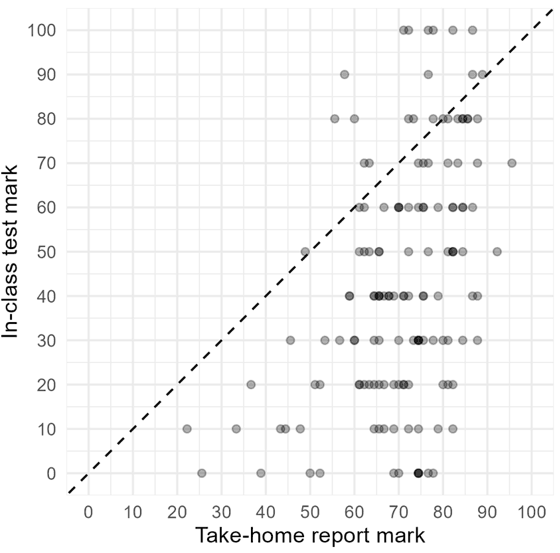
The average mark for the in-class micro-test was 42.7%—fully 27.7 marks lower than the take-home element. Recall that this test was asking students for identical information to that which they had submitted two weeks prior, so we would expect students who have been able to do this in their own time, to be able to replicate this in class.
This difference in marks was also reflected in the limited Pearson Correlation Coefficient of 0.43. This is also visually evident in the scatter plot in Figure 1: with highly correlated results we would expect the points to lie on the 45-degree line, but most of our points are below—indicating that students generally scored much higher in the take-home element. Indeed, as we can see in Figure 1, there were 7 students who scored over 70 in the take-home, but zero when asked to replicate their knowledge and understanding in-person.
Figure 1: Take-home versus In-class Micro-test Marks
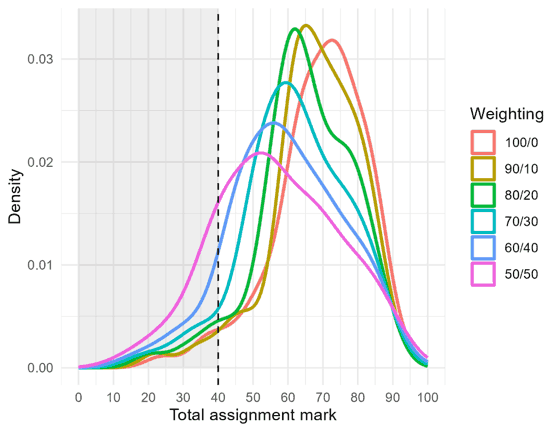
This combination of assessments also demonstrated the potential for micro-testing to 'deflate' the marks of take-home assessments which have become distorted upward by students delegating work to their AI assistants. When incorporating the micro-testing component (weighted at 10%), the average mark decreased to 68%.
Figure 2 shows the effect on the marks distribution of introducing the micro-test at 10% weighting. It also shows a range of alternative hypothetical distributions; for example, a 20% weighting would have reduced the average further to 65. In addition to lowering the average, the micro-testing also created more dispersed and symmetrical distributions.
Figure 2: Assessment Mark Distribution Under Different Weightings
Important considerations
To accommodate students with approved exceptional circumstances or additional time requirements, a catch-up session was organised at the end of the term. Students requiring extra time were seated discreetly, and their scripts were collected separately.
Further to the specific example given in our case study, micro-testing is not limited to individual assessments, and has scope for many adaptations to a variety of different assessment tasks. For example, we implemented it in a follow-up econometrics module involving group reports (results forthcoming) to ensure that all students engaged with the entire report rather than only their assigned sections, and to better recognise individual contributions, micro-tests included questions covering all parts of the group work. The structure remained as described above.
Conclusion
Micro-testing is a readily-implemented teaching intervention that enables lecturers to verify students’ understanding of submitted remote assignments and is particularly relevant if educators are worried that students are delegating too much work to AI—a problem which essentially boils down to concern over authorship. Although disarmingly simple in execution, micro-testing is far from simplistic; it aligns students' incentives toward meaningful engagement with take-home tasks, while overcoming many of the barriers that prevent widespread adoption of many AI-mitigating assessment approaches (i.e. resourcing and perceived complexity).
In the context of present concerns about AI generation of student work, micro-testing achieves two forms of mitigation:
Through the afore-mentioned incentive effect, it can—particularly in repeated use—discourage surface learning, such as uncritical reliance on generative AI outputs, and drive the desired (from an educator perspective) deeper engagement with remote tasks.
Where there is a suspicion of over-use of generative AI, it can be used to produce a distribution of marks that more accurately reflects students’ domain-specific learning.
In conclusion, many remote assessment tasks (e.g. essays, projects, briefing notes) have become fundamentally compromised in the present age of AI—leading to justified questions over their validity as tools to assess students' learning. The properties of micro-testing, when implemented, restore this validity, allowing educators to retain remote assessments—with all their associated benefits—as part of a balanced assessment portfolio.
If you are interested in implementing micro-testing in your own modules, the authors would be very happy to discuss the approach and follow up on any results. Feel free to contact either Tim Burnett (t.burnett at aston.ac.uk) or Robert Riegler (r.riegler at aston.ac.uk).
Notes
^ 1. In this respect, it could also be employed in any situation where there is widespread concern about authorship of student assessments, or concerns about mass collusion or commissioning.